
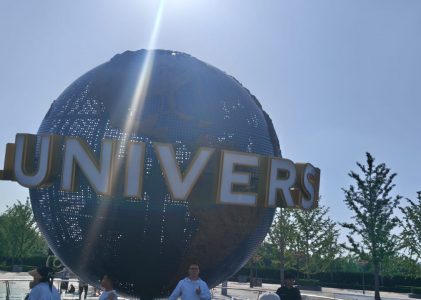
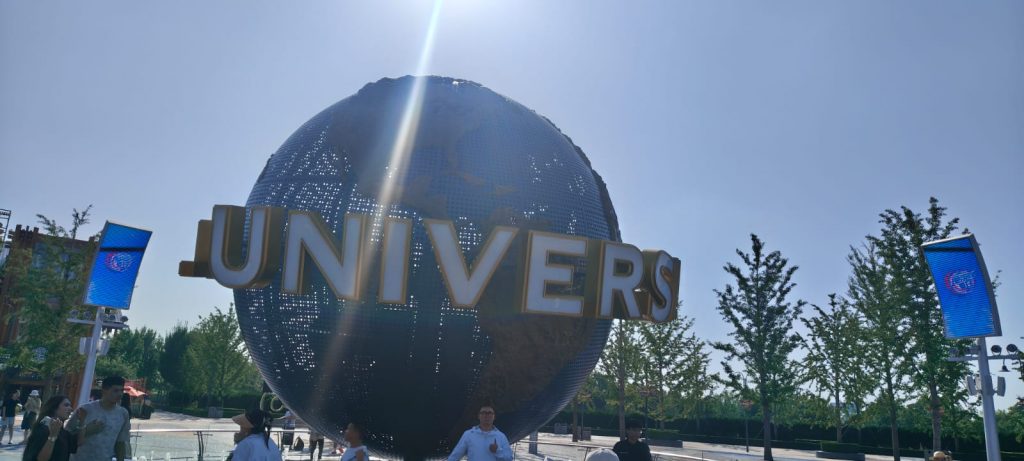
I was standing in Beijing in July, in temperatures of around 35 degrees and humidity so high that, as a Central European, all you can really think about is which air-conditioned space to head for next. All around me were people in black robes.
Harry Potter. Female Harry Potters. A great many of them.
At Universal Beijing Resort, they were waiting to have their picture taken in front of the Hogwarts Express. Black robe. Wand. 35 degrees. At first, I smiled at the sight. Then I stopped laughing fairly quickly. Because at some point I thought: as a producer, t here ishardly anything more you can achieve.
For decades, we have been fighting to get people to spend time with our stories. We discuss market shares, ratings, streams, views, completion rates and, by now, whether the first three seconds of a video are exciting enough. And there are people standing around, sweating voluntarily in black robes because they want to be part of a story for a few hours. Perhaps, when we talk about IP, we are talking about the wrong thing.
We discuss content, productions, budgets and Heads of Department, indulging our own vanities and those of others. But perhaps we should talk more about lifetime.
After all, lifetime is humanity's most valuable currency. And it has a rather inconvenient characteristic: it cannot be scaled.
By now, we can produce virtually unlimited amounts of content. Distribution is no longer a bottleneck anyway. Streaming, YouTube, TikTok, Instagram, podcasts, games, creators, broadcasters and media libraries are all competing for the same 24 hours. AI will increase the supply even further because production is becoming faster and cheaper.
But people do not get a 25th hour.
One number keeps coming up in this context: more than eleven hours of daily media consumption in the US. It comes, among other sources, from the Nielsen Total Audience Report and was already recorded back in 2018. At the time, Nielsen spoke of more than eleven hours of daily interaction with media. Important to note: that is not eleven hours consumed neatly one after another. Media run in parallel. Smartphone while watching TV. Audio while working. Second screen alongside first screen. From a producer's point of view, you might say: excellent. More media time.
I am no longer so sure.
Perhaps we have, at some point, pretty much exhausted the limit of what additional screen time we can gain. Perhaps the more interesting question by now is no longer how we get another ten minutes. But what an hour with our story is actually worth. And then, of all things, the real world becomes interesting again.
Perhaps the business only really begins after the credits roll.
Location based entertainment, immersive shows, theme parks, exhibitions, pop-ups, theatre, live entertainment. That sounds a bit like the secondary exploitation people eventually mention once a film or series has been successful. Perhaps that is exactly the mistake.
McKinsey published a fairly notable piece on location-based entertainment in early 2026. The consulting firm sees smaller, regional and temporary experiences as a growth field for brands and IP owners right now. According to their research, Gen Z visits immersive experiences 1.5 times more often than the general population, and four times more often than older generations.
The market forecasts are notable too, though such forecasts should always be taken with a grain of salt. Grand View Research puts the global market for location-based entertainment at 7.4 billion dollars in 2025 and expects it to reach 49.2 billion by 2033. That would be annual growth of just over 26 percent.
Why? Maybe also because at some point we've simply had enough screen.
Eventbrite names "Reset to Real" as one of its trends for 2026. 79 percent of the 18- to 35-year-olds surveyed there want to attend more events in 2026. What people are looking for, according to the study, are experiences that can't be perfectly reproduced or choreographed, but instead make encounter and participation possible. Eventbrite earns its money with events, so it's hardly a neutral scientific source. But I still find the description fairly on point.
Reset to real.
Maybe that's why the people in Beijing weren't standing around in their Hogwarts robes despite our fully digitalized media world. Maybe they were also standing there a little bit because of it.
We produce stories. Others build worlds.
Harry Potter is admittedly the most unfair example imaginable. One of the biggest entertainment IPs in the world, Warner Bros., Universal, billions in investment. Drawing a lesson from that for a German producer would be about as helpful as telling a mid-sized machine manufacturer to just go ahead and become Apple.
Which is why it gets interesting one size down. And suddenly we end up with a small story I was part of myself. Once again — Ku'damm.
When we made Ku'damm for ZDF, we made television, first and foremost. A story, characters, a world. Later, together with BMG, Annette Hess, Peter Plate and Ulf Leo Sommer, it became a musical. That wasn't an automatic extension of a TV success. Different partners, rights, creatives and interests had to come together. In my own professional retrospective, I describe exactly this path from television material to the stage.
And with that, something strange happens to a TV IP. People no longer just watch it on a screen. They travel somewhere. They buy a ticket. They sit with other people in a room. They spend an evening with this story. Maybe they go out to eat first. Maybe they have a drink afterward. People work in the theatre, on stage, in technical crew, at the bar, in marketing, at the box office. Suddenly, a story creates movement.
And movement creates economy. We finance works. Others finance worlds.
Which is why I find Michael Mack particularly interesting right now. With him, the logic runs almost in reverse. Ed and Edda started out as Europa-Park characters. Then, with "Grand Prix of Europe", they became a 90-minute theatrical film, produced by Michael Mack and MACK Magic in co-production with Warner Bros. Film Productions Germany. At the same time, Europa-Park opened "Grand Prix EDventure", an interactive 3D dark ride. Then came a video game, VR, an ice show and licensed products. According to MACK, the film itself reached more than two million cinema visitors in 52 countries by November 2025.
I find that remarkable. The classic film producer develops a film and, at some point after success, asks: What else can we make out of this?
Mack owns a world and can ask: Where does this world take place next? In the park. In cinemas. In a game. As a VR experience. On products. And then back in the park again. That's a completely different architecture of IP.
In 2025, more than seven million people visited the Europa-Park Resort for the first time. Obviously not because of Ed and Edda alone, that would be nonsense to claim. But it shows the scale of an entertainment economy in which stories don't exist solely to get people in front of a screen. And you don't even need a theme park for that.
I find that almost even more exciting.
In Shanghai and Shenzhen, I visited a number of immersive theatre pieces and escape rooms. In Berlin, I can currently visit "The Jury Experience", for instance, an immersive courtroom drama. The audience doesn't just sit in a theatre watching other people perform, they become the jury themselves. The story demands a decision.
Compared to a theme park, the business model behind it is almost quaintly small. One location. Performers. Technical crew. Dramaturgy. Marketing. Ticketing. But the principle is the same.
I'm not just paying to watch a story. I'm paying to appear in it. And suddenly storytelling turns into something else. The story needs a place. The place needs people. Those people need other people to run the place.
And that creates jobs an additional streaming episode never would have. What a story is still worth after it ends can now be measured economically, too.
The Warner Bros. Studio Tour London is a fairly clear example of this. 28 percent of visitors came from abroad in 2019. An economic impact analysis identified 424 direct jobs at the Studio Tour. Including indirect and induced effects, the study calculated 605 full-time equivalents and 75.2 million pounds in additional gross value added for the local economy.
ABBA Voyage is even more extreme.
Not really a film IP at all. Which is exactly why I find it interesting. Music, characters, technology and a physical place become one new product. For the first year, an additional gross value added of 177.7 million pounds was calculated for the London economy; more than 5,000 jobs were supported, directly and indirectly. By the end of 2024, around three million tickets had been sold.
The old songs already existed before. The IP already existed. What was new was the world they were placed into. And that's where the uncomfortable question about our own industry starts for me.
Why do we so often think of IP only from the work outward?
Perhaps that has less to do with a lack of imagination than I first thought. Our production system is built to finance projects. Film. Series. Season. Broadcaster. Platform. Funding. Production costs.
And then come the rights.
In a classic, fully financed commissioned production, the commissioning party bears a large share of the economic risk and, in return, receives extensive usage rights. That's understandable. But for a producer, it changes the economic incentive to invest capital long-term in a world built around an IP.
Ku'damm shows it can still work.
But it takes partners. The British system is built differently at this point. Since 2003, the Terms of Trade there have given independent producers a stronger position when it comes to long-term ownership and exploitation of their IP. The British producers' association Pact attributes a significant share of the independent sector's growth to this structure. The fundamental difference in the system is interesting, and the question is allowed: why do questions about IP rights at production companies so quickly end at "that belongs to the commissioning party", and why does nobody want to talk to the commissioning parties themselves? Do they really make it that hard for us, or is it simply more comfortable to stay in the old system for as long as it still works?
Because someone who owns a storyworld, or could own one, thinks differently about its future than someone who gets paid to produce it. Maybe that's one of our real problems.
We talk about IP. But we finance works. Not worlds.
And now I come back to the sweating Harry Potters in Beijing. Maybe we've undervalued lifetime in our industry for years.
A stream scales beautifully. One additional viewer costs almost nothing extra. That's why we love reach.
A night at the theatre is terribly inefficient. People have to travel somewhere. Performers have to get back on stage every single evening. Someone has to run the lights. Someone has to open the door. Someone sells overpriced drinks during intermission.
And that's exactly why this evening is lifetime that has to be valued differently. It's happening right now. For the audience, and for the people who make the evening possible. Not tomorrow. At least not in that same form.
I can't watch it at 1.5x speed. I can't open three other plays at the same time. And next to me sits another person. Someone I can actually talk to right afterward, if I want to!
Maybe, in a world of unlimited available digital content, this exact inefficiency suddenly gains a higher economic value. In that case, the next big opportunity for film producers wouldn't necessarily be producing even more screen minutes. It would be building stories that get people off their sofa.
That doesn't mean every series now needs a dark ride. Please, no. It also doesn't mean Germany should build twenty theme parks.
I find McKinsey's analysis interesting for exactly this reason, because it points to smaller formats. Temporary experiences. Regional installations. Pop-ups. Immersive shows. Formats that let you test, with far less capital, whether people actually want to step into a world.
Maybe we also need a different kind of producer for this. People who understand film and live at the same time. Dramaturgy and visitor flows. IP and hospitality. Storytelling and games. Production and physical spaces. A little bit of self-promotion can't hurt here, can it? Call! Me!
And maybe that's exactly where jobs get created, while somewhere else we're arguing, quite desperately, about which jobs AI might make obsolete in classic media production.
That would at least be a refreshingly different perspective.
After nearly 30 years in film production, I've spent a great deal of time getting people to watch stories. Maybe a time is beginning right now in which we should once again focus more on getting them to experience stories.
Not as a replacement for film. As the next stage of exploitation for a good idea.
Because the scarcest resource in our industry won't be content. We're more likely to have too much of that.
It will be lifetime.
And maybe that's why we should stop measuring a story's success only by how many people watched it. Or by how long they watched it, which is an absurd discussion in itself: judging whether 30 minutes of watch time out of a 90-minute film counts as a success is simply wrong. The viewer has effectively switched off!
What increasingly interests me is what people are willing to do for a story.
Do they travel to Berlin for it? To Munich? To Stuttgart? Do they buy a ticket? Or more than one? Do they meet other people? Do they want to be part of it? Do they come back?
And do they, for that reason, stand at 35 degrees in the shade in Beijing, wearing a black Hogwarts robe, in front of a train, waving a wand?
Then maybe we've created something more valuable than one more hour of watchtime. We've turned a part of their life into a memory. And apparently, people are even willing to leave the screen behind for that.